Friday, June 12, 2009

Ghost Ranch


I first came to Ghost Ranch in 1963. I had finished my freshman year at Wagner College in New York City so I got on a Greyhound bus and spent two, maybe three, days travelling from the Port Authority bus terminal on 42nd Street to Santa Fe, New Mexico. Staff from the ranch picked me up in Santa Fe, fed me some green chili which was the hottest food I had ever eaten, and we drove up past Abiquiu to this new world.

The new world is still here...I continue to discover it each year. Yesterday morning the colors of the desert were vivid after some rain fell during the night. The small arroyos and larger canyons had a new layer of sandstone mud, red and dark brown; the few bushes seemed refreshed; the view across the Piedre Lumbre Llanos was clear to Pedernal, the huge caldera that forms the focal point of the valley.

That first summer Georgia O'Keefe still lived on the ranch and painted from her studio in a small adobe house. The house is still there, down the road from where I hiked in the morning, searching the arroyos for stones, artifacts, bones...the detritus that the rains might have uncovered. She also found beauty in the landscape. She claimed that God told her if she painted Pedernal (the high mountain across the valley) enough times God would give it to her. Maybe God did...but the mountain was still here in the morning as I search for my own kind of beauty.

Friday, May 29, 2009

Meeker

We came out to Meeker in the northwest corner of Colorado to do a pre-feasibility study of a potential small scale hydropower project. The old hydro plant was built in 1911. It has been abandoned for the past 50 years but the ditch has been maintained. Can you build a new plant? Sure can.

Meeker was named for an Indian agent who was killed by the Utes when he tried to force them to become agriculturalists ("they didn't like to do yard work," is how a friend put it). So the US Government sent in the army, killed a lot of Utes, and forced them out of the state on a Utah (think of the irony of the name) reservation.

Beautiful, isolated valley. Small town (population 2,200). Fertile but wet land on the valley floor. White River runs through it. Hills green from the recent rains. The river runs high.

Hard life. Marie Carter is grazing her horses, getting them in shape for the summer visitors whom they will carry on their backs onto the Flat Tops. She is trying to keep the guide business going. Her husband died last year in a freak accident when the tractor he was driving flipped over on a soft shoulder and landed on top of him. Actually he didn't die then. He died when they pulled the tractor off of him and his insides spilled out. His wife and kids were there. Her son is going to help her this summer. He's just about old enough to start high school.

Monday, April 20, 2009

Home

So flying from Rabat to Paris, I'm back in the "international style" of travel. The Charles de Gaulle airport is great architecture, but it's hard to get from terminal to terminal and when your plane is delayed, well, sleeping on the floor of an airport has the same feel regardless of architect's vision.

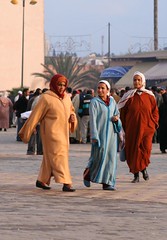
Of the images of Morocco, the ones that stick in my head are the abrupt contrasts between the traditional and the modern: the burka clad women riding their mopeds as aggressively as any teenager in Italy, the young guys surfing on the Rabat beach under the high walls of the kasbah, the modern trains rolling through fields of wheat being harvested by hand, the broad boulevards named after the king's grandfather which end at the gates to the old walled city.... I left without a sense of how these opposites fit together and, yet, in some way they does. Perhaps the contrast is just in my mind. This westerner who does not understand el Magrib, the "far west" that Morocco represented to the Arab world of North Aftica, this place of Berbers, Arabs, the French and the Spanish, the African and the European...this middle earth.

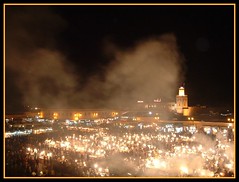
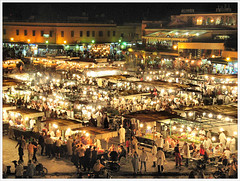
On my last night in Marrakesh, I paid admittance to one of the terraces overlooking the Jemma el Fna...that great plaza filled with vendors, story tellers, tourists, musicians, food stalls and sellers of herbs and medicines. I found myself standing next to an American woman, living in Germany, who was in Morocco as part of a tour group. As we talked, I shot some video of the scene unfolding beneath us...as it does every night...a scene populated by Moroccans, doing what they have done for many, many years at this northern terminus of the Sahara caravans that once moved ivory, slaves, salt across the desert.

Sunday, April 12, 2009

Surfs up in Rabat

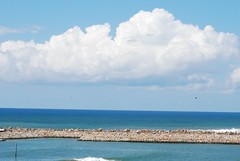
Am back in Rabat, flying on Air France tomorrow back to Paris and then to the Colorado Mountains. The beach below the ramparts of the kasbah is home to restaurants, games of soccer, and surf clubs...the current monarch being a founding member of the Rabat Beach Surf Club. The ocean is cold. Morning fogs form but usually burn off by noon. There is a serious need for wet suits. The surfers keep within two long sets of huge stone breakwaters that stretch out into the ocean, protecting the river and the cities, Rabat on one side and Sale on the other, from the ocean waves.


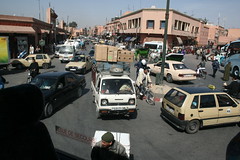
In some ways like the surfers I have just been skimming the waves here in Morocco, riding the surface impressions, not getting very much beyond the immediate sights and sounds. Atheletically, the main sport, principally found in Marrakesh, was in crossing city streets...learning to just go ahead across the street and not hesitating. One evening I followed the lead of two guys as they crossed right through the middle of a huge roundabout...cars, trucks, mopeds swirling about us...the vehicles do not go round the circle as much as draw more or less direct lines through it...we just kept on walking. On safely reaching the other side, I had the impression I was finally able to figure out a little of the psychology of living here. And, at the same time, I was still alive. Great trip.

Friday, April 10, 2009

Jamma El Fna

A great human configuration takes place each night in this plaza. The plaza lies close by the great minaret of the Almohads, completed in the year 1175. It is a place for snake charmers, musicians, acrobats, hustlers, beggers, story tellers, sellers of herbs and medicines...who come to be surrounded by groups formed from the thousands of Moroccans who find this as a kind of ultimate street art. Some have seen this as the place where the sub Sahara tribes and their goods met those from the north, from Spain and Europe, from the Atlas Mountains whose snows are in the distance. And now all these places and peoples are joined by the European tourists who find this a key part of their vacation package.
But what I have noticed as the thousands converge each night is that the tourists are either on the terraces of the restaurants that surround the plaza or down eating in the hundreds of tents that serve up lamb, chicken, sheep heads, snails, oranges, soups, nuts, tajines, couscous and serve them on long tables, the staff calling out to you in French. Spanish, English to sit down and eat by the hundreds. As if Times Square were converted each evening into a vast foodie emporium where all the world sat down and ate together.

Thursday, April 9, 2009

Jardin Majorelle


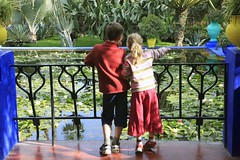
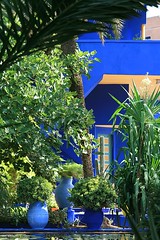
Today I spent in the New City, full of cafes, cars, new construction..."are you interested in a condo in Marrakesh, monsieur?"...and people and tourists going about their lives. Among the visual icons of the city are the gardens bought, restored, and then donated to it by Yves St. Laurant, the French designer and his partner Pierre Berge. The gardens were first begun by Jacques Majorelle, a French artist who lived for many years in Marrakesh in the last century.


The gardens represent a kind of high concept French and Moroccan design interaction in the choice and placement of trees, plants, walkways, gezebos, fountains. The plants are rare and spectacular examples of palms, cactus, bougainvillea, bamboo, water lillies, the plants of palace gardens. But it is really in the design and interaction with cobalt blue pavilions that the experience of walking through the garden comes together. And imposes its own high toned tranquility. Whose pleasure was increased by the hour or two I spent in the cafe within the gardens, talking with some young German tourists escaping from winter and wet spring in Dusseldorf.

So there is this whole high end design scene, in gardens, in home decor, in architecture, in Marrakesh that seems far from the mountain village I stayed in last week but which is connected in the designs of pottery and simple house types. And perhaps in some way connected to the rush of traffic in the streets just beyond the high garden walls. But I did not see the connections as I tried to stay out of the way of careening taxis and wayward mopeds.

Marrakesh

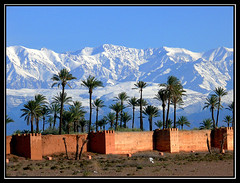
And then there is this huge city, this destination vacation land, this Orlando of the northern fringe of the Sahara. The train station, its scale, openness, terraces, shops and sleek lines is a marvel. In itself, worth the trip. And, then, unexpected for me, the high snow covered peaks of the Atlas mountains that frame the city. Quite like the high Front Range strikes above the Denver skyline. I look again to make sure I am in the right place, continent, and after getting several sets of directions arrive at the hotel.

So Marrakesh has its traditions, its past as an imperial city...from which the Almoravids and Almohads ruled north to Spain and south to Niger, holding together rich trade routes in cloth, slaves, jewels...but it also has its present incarnation as the destination of huge tour buses or package tours. European families with children and strollers and cameras crowd the souks during the day. But the sun is bright, the air is dry...if somewhat full of pollution from cars and mopeds...and the spirit is one of a holiday town.

Toward Marrakesh

A train leaves Tangier promptly at 8:00 and travels south along the Atlantic coast, making me feel I should just get off and watch the waves for a few days. But my ticket says Marrakesh, so I stay in the compartment with my fellow travellers, a government official and a woman returning from a few years in Spain. We stop in Casablanca to switch trains which takes a while to figure out. I have noticed that when you ask people a question like "Cest la voie pour le train a Marrakesh?" and they say "Oui" because they are waiting too, they will check to make sure when the train arrives that you get on. Looking out for the wayfaring stranger.

From Casablanca, the land gets more open. Winter wheat ripens in large fields...I never see a fence between holdings. But I was told earlier that everyone knows where the boundaries are. I see no evidence of farm mechanization, only solitary individuals, mostly women, working in the fields or watching flocks of sheep or goats. The land gets still dryer and the few villages that appear take the form of small walled compounds, everything facing inward, only the thick mud and stone walls facing the world. The train speeds on. The service cart comes around coffee and sandwiches. Kids play in the train corridor. The land gets drier. I am struck by the seeming lack of connection between the train on which I ride and the world I few ever so fleetingly.

Monday, April 6, 2009

On the beach


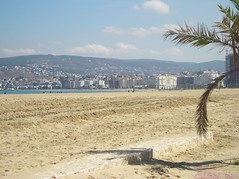
Funny how you start out the day thinking one thing would happen and, then, after checking into a bare bones hotel for 16 dollars a night here in Tangiers, after a ride in the mountains, and getting to the train station to buy a ticket to Marrakesh for the morning, and not getting a cab, I started to walk back and, then, there was the Mediteranean and this wide wide beach and while not being Miami, it did have all of the attributes of a beach town with the huge ferries coming in from Spain dropping off their pale passengers who will scatter to beach towns, more Miami like, further east along the coast.

Sunday, April 5, 2009

In the Rif


Rif rhymes with kif, the local name for marijuana, which is the ,ain traditional crop here so there is this sense that some varient of John Denver is singing about getting high. But I spent last night on one of these farms in an isolated part of the mountains. The government has recently forbidden its cultivation...so production has simply moved further East. But this was a farm stay arranged by a non profit group trying to bring additional resources into these rural areas. So we looked at the agriculture, the small pottery business run by the woman of the house, did some hiking, and had by far the best food I have had thus far in Maroc.

This morning we hiked out about three hours, eventually coming out at a Sunday souk. The souk is held appropriately in what is now a town called Souk El Har or Sunday Souk. It is located on the local highway right at the dividing line between what had been French and Spanish controlled parts of the country. We checked out the scene and then crowded into a collective taxi for the ride back to Chaouen. The town is positively crowded with Spanish tourists here for the Samana Santa...kind of like a reconquista this time with tourist pesos instead of troops.

Friday, April 3, 2009

Hammam

The hammam in Chaychaouen is just around the corner from the main square in front of the old kasbah. It is open to men in the morning and evening and in the afternoon in the afternoon. The hammam is like a communal sauna except wet but not quite a steam room since the water comes from a tap in the wall where it has been heated in an underground furnace burning the wood from olive trees. You get an empty bucket and bowl to pour the water over you and basically everyone sits around in their underwear and is cleansed.

I have decided to spend tomorrow in a rural village, a program organized through a nonprofit under a grant from a university in Barcelona. I am enjoying taking it one day at a time, leaving things open to see what develops as the day unfolds but still having a general idea of where I want to go. I was thinking of maybe just staying here in the north and checking out local sights and history, but I have decided to take the train to Marrakesh for my last long visit in the country.

Thursday, April 2, 2009

Chafchaouen


So this is a small village, a small blue village, a beutiful Andalusian blue village. Andalusia was and is Morocco as well as Spain. A vegetable market is going on at the Bab Souk...the Market Gate...down the street; women from the Berber villages up the mountainside bringing in cilantro, carrots, legumes, potatoes, oranges for sale. The most imortant local crop is kif, smuggled in great quantity to Spain a few miles and an European Union away, across the narrow strait of Gibralter.


Am staying at another riad, a small inn designed with an interior court, terraces overlooking the village, and Moroccan design in terms of crafts, architecture, narrow stairways, and lots of light. This part of Morocco was controlled by Spain...which still maintains several small ports along the coast, ten miles or so from here...so there is a lot of Spanish spoken which I easily mix into my French, but no one seems to mind. In the first countyard of the riad are a set of tiles in Spanish and Arabic. A old Spanish tile reads "Dale limonsa mujer no hay en la vida nada como la pena de ser ciego en Granda" "Give him alms madam there is nothing in life more painful than to be a blind man in Grenada." The same holds true for this blue village on the other side of the strait.

On another road


Left Fez feeling the need for a more tranquil setting...after all I do live in a small town. So after being told by the driver of a petit taxi...the small taxis that can only drive in the city...that there was no way to get from there to here...I had him drop me at the bus station. I had thought I could get a grand taxi...they go between cities and towns when they fill up with enough passangers, usually seven in a small sedan...but I was wrong. Turns out I would have had to change in several towns on the way.


I was two hours early for the bus, so I had another couple cups of coffee with milk and studied my French. The trip to Chafchaouen took about four hours through countryside that was at first rolling hills but which grew increasingly verticle and the road led through narrow gorges through clouds and light rain, higher and colder, until we rounded a bend and there was the town across yet another valley.

Tuesday, March 31, 2009

Fez


And then you experience something so different and that is like being in Fez, if just for a day. I rode over this morning in a grand taxi and I wondered how that was going to work because there were seven of us fairly big guys hanging around and it was a very small corolla sized car. But I learned we could all fit...the first surprise of the day.

But then I got a petit taxi to the old...I mean old since Fez just celebrated the 1200th anniversary of its founding...and well the medina, the souks, the mosques...it is all up there with Times Square, the pallazos in Venice, Tenamin Square as urban places of human activity. Just overwhelming in sight and sound and smell. Some of the last coming from the urine and feces baths used for tanning hides. Just an astonishing place...made me come back and spend the rest of the afternoon with a glass of wine...yes, it can be obtained in certain hotels in the ville neuvelle...reading the history of Fez and Morocco which was, by the way, the first country to recognize the US after the revolution and with whom it has the oldest treaty of any other country in the world. Kind of had to do with piracy at the time...but still.

Monday, March 30, 2009

But really it is about people


But really it is about people. The people you watch while having a morning or afternoon or evening coffee at one of the sidewalk cafes filled with men doing the same thing. Women can eat in restaurants but I have only seen two thus far sitting in a cafe. Or the people who help me out with my unhappy version of French. Or the baker tended the wood fire in a small village who offered me bread and warm milk. Or Simo at the riad this afternoon who made telephone reservations for me at the next two places to which I am travelling. Shukran, thanks, to you all.

Volubilis


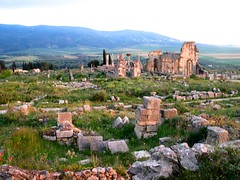
I hired a taxi this morning to take me to the Roman ruins of Volubilis, one of the most western outposts of the empire. The city persisted here in these Atlas mountains long after the empire fell, but eventually it was abandoned, its most intact columns carried away support the immense gateways of palace complex of Moulay Ismael in the 18th century. And still we are in a kingdom, albeit a somewhat constitutional one. But visiting such sites on a rainy spring morning helps provide perspective on the rise and fall of contempory powers. And how spring comes quite of its own free will.

Sunday, March 29, 2009

Rain and Cold


So this morning as the rain began again, I visited the rooftop of the medersa, the school attached to the main mosque here in the old walled city of Meknes. These tiles form part of its roof. Below the roof, the intricate carving of vines, lines, and Arabic letters form the walls of the inner courtyard around. Around the courtyard; the students simple rooms are alligned. This madrasa is one of the very few Muslim holy places that non Muslims...including Quakers...are not allowed to enter.

But the rain continued all day, so my planned visits to the villages and Roman ruins outside the city were put on hold. Instead I went over to the Ville Novelle and bought myself a light weight jacket to stay warm, had lunch at a restaurant whose love of cats I did not appreciate, and with the help of Simo, the excellent host of the riad where I am staying, fugured out how to buy a bottle of wine...have to go to a supermarket in the new town...cab ride back and forth...one cab driver was listening to prayers in Arabic, but I figured that was like listening to Focus on the Family while riding through Colorado Springs.

But if you think this is easy, I am typing on a keyboard on which I have to remember that the a, the m, the w, the z, the , and the . are on different keys. Of course, that must be easier than writting in Arabic script backwards, but actually the spaces are set to go from right to left if you are using that script on Word.

Saturday, March 28, 2009

On the railroad


I was not prepared for the green, fertile countryside that sped by the second floor windows of the smooth, comfortable train I rode this morning up from Rabat to Meknes. The train beat any line I have ever been on in the US. I wonder how my country ever got so far behind in the development of transport. Maybe we got too excited about the low prices at Wallmart and we thought that was progress. Something about you know better what to do with your money than the government does. We lost decades of infrastructure investment believing that Republican tag line.


Maybe it is just that we stereotype not only other parts of the world, but ourselves as well. I am in a walled city in a cyber store filled with men and women and even families, reading emails, talking on Skype, listening to music. So where really are the walls that nations keep on putting up? They must be, in large part, in our heads.

Friday, March 27, 2009

Reading and Writing


I have so far learned six Arabic letters. There are 28 letters (only two more than English) which sounds easy except that each letter changes shape depending upon its position in the word. So the letter shape shifts if it is the first position, the last position, or somewhere in between. Like English, the letters look different if they are printed or in cursive, though it doesn't appear that people use printing for regular communication (unlike in English where you can always fall back on printing when the cursive becomes unintelligable). Like English, the phoneme the letter is linked to changes so the pronunciation is never quite clear. Unlike European languages, Arabic is written from right to left, but numbers are from left to right.

So when I'm walking down the street and see a sign, I try to identify the letters that I know...kind of like what I probably did when I was three or four. I can almost feel my brain working, trying to make neuroconnections that have not had to be reworked for a long, long time. Actually sometimes it seems I can hear my brain working on this. Exercise for the brain.

Thursday, March 26, 2009

In the Medina


I flew into Rabat yesterday...am staying in a small riad...a bread and breakfast composed of six rooms around a three story courtyard in a house several hundred years old. The medina is the old walled city, narrow streets that cars can not enter, high blank walls whose only openings are ornate, massive doors which lead onto inner courtyards. On a high cliff above the sea just across from the medina is the kasbah, the old fort. Down the hill from the kasbah is the Oudaya Surfing Club, one of whose founding members is the king.

Outside the walls of the medina is the Ville Nouvelle, the new town established by the French when Morocco became a colony. Instead of tearing down the city walls, the French simply built an entirely new city with characteristic broad boulevards, now lined with stores, cafes, and banks. It is a pattern repeated throughout the country...the old city and the new city, side by side.

That is some of the basic geography...now to try to understand what is going on.