Wednesday, March 23, 2011

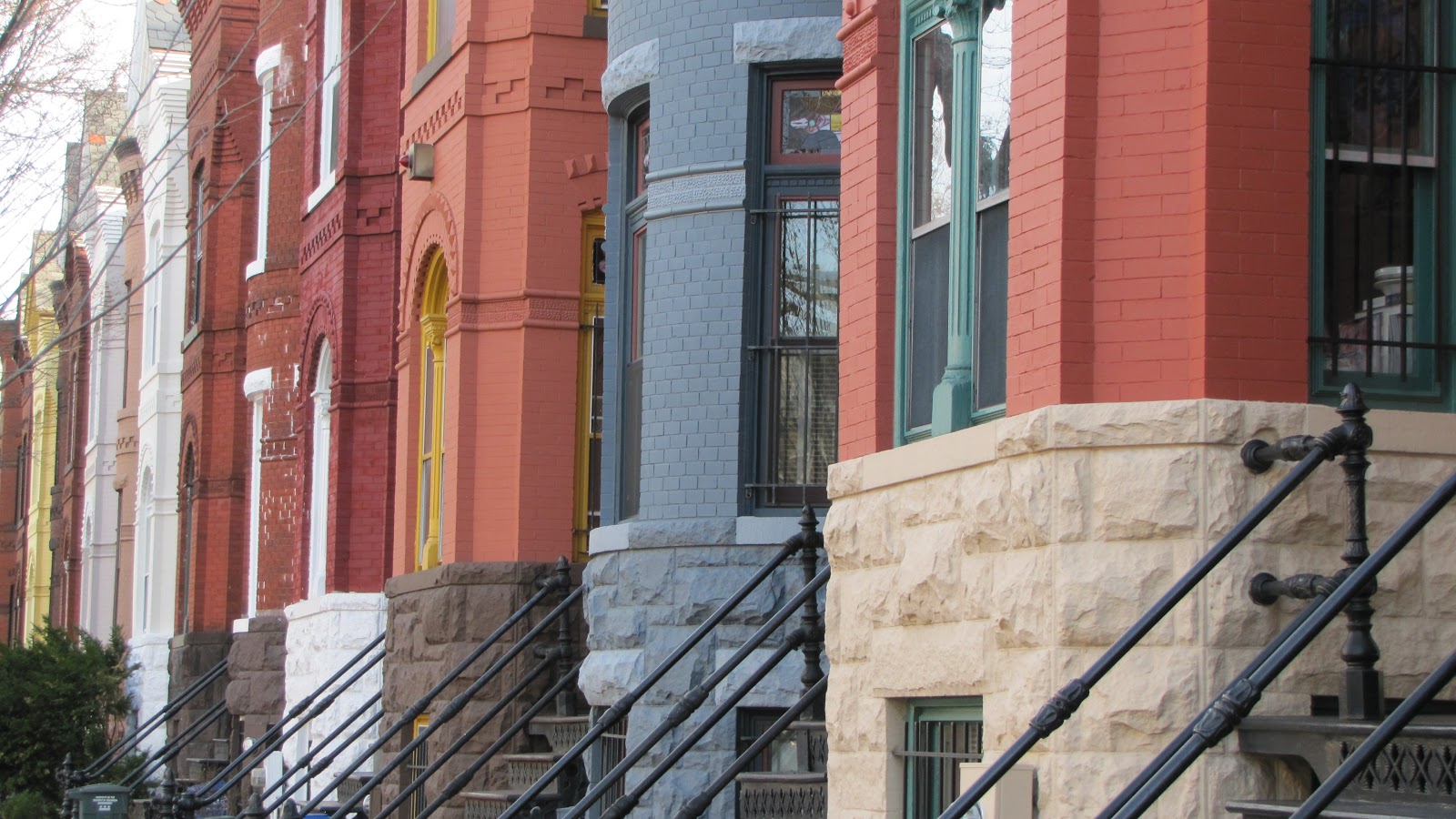
The Neighborhood


I've been staying at my son Tom's house on Capitol Hill in Washington...six blocks in back of the Capitol Building, the Library of Congress and the Supreme Court.   It is a dense residential neighborhood of row houses, manors, modest frame dwellings...most of which lie within a tightly regulated historic district.  The district ensures that almost no change can be made in the exterior of the houses.  So each trip around its many blocks reveals its many shapes and forms; each residence having its own unique story and lore.


But besides the structures, the neighborhood ("near""dwelling""place") is the people who live there.  The children who ride in wagons for their afternoon "walk" from the local day care center.  The woman trying to decide on flowers in Eastern Market, built in 1873 and still housing all range of food vendors.  And folks in their houses and flats, sorting out their lives and possessions and networks.  The neighborhood is a kind of tapestry of structural and human interactions, played out in a live street museum, set just in back of the major institutions of our federal government.  A place for people behind the people's courts and legislative bodies.


Tuesday, March 22, 2011

Skijoring

 So you put together horses, cowboys, skis, and snow in the middle of the downtown business district and you get Leadville's version of skijoring.  "Joring" comes from the Norwegian word for "driving"...and in some parts of Scandinavia, it involves skiers being pulled by dogs over long race tracks.

But in Leadville, a horse and rider pull a skier on a rope to launch him over a series of jumps.  The skier has to snag bright rings which are lined up between the jumps by putting his arm through them (which involves switching the hand holding the rope).  The skiers, at least those who complete the jumps, are timed.  The winner is the skier with the fastest time and the greatest number of rings.


These horses move fast, around 40 miles an hour down the flat center of the course.  The jumps and rings are arrayed on each side of this center aisle.  The skier must move from side to side, jumping and grabbing rings.  Times for running the course average under 20 seconds.   


Of course, not every skier makes it to the end of the course still on his skis.  Some wipe out entirely after the first jump.   But the competition has been going on since 1949 and is one of the central winter festivals of this small mining town (which boasts at being the highest incorporated city in the United States, located at 10,152 feet more or less).  And the color of the event is not just the competition itself, but also the spectators who line the main street, the sometimes colorful horses (spraypainted?), and the setting in this old mining town.  


As the competition came to a close, it seemed a fitting end to my month of skiing in the mountains.  Tho' at no point did I think it was time to take up myself this "new" sport.


Tuesday, March 1, 2011

Art from the sidewalk

Salida has a strong presence in the arts.  Evidence is the number of art galleries per capita.  Wallmart and other businesses line the strip along Route 50 but the historic core of the town forms the art gallery-coffee shop-yoga studio-bar-restaurant center of urban life.

What is more striking, though, is the integration of folk art and ornamentation into the many small houses that fill out that urban core.  Small home owners decorate their houses with ornaments, found objects, small statues and architectural fancies, probably extending out a Victorian tradition that was the rage when in 1880 trains arrived to make the town a commercial and industrial success.  


 So a walk down the street asks the visitor to move slowly...note the small works of art and artifice that populate the yards and add color and design and life to function.  Form does not follow function here...form has an individualistic small-scale artistic sensibility of its own.   

Monday, February 21, 2011

Price reduced


This past week, I went looking for trails, passes over the mountains, to scout out for snowshoeing or cross country skiing.  Sun and warm temperatures filled the valley...one had to drive or hike into the hills to find snow.  Or ice as in ice fishing...a sport little understood by your blogger.  

And on these hikes and drives come constant reminders of how the economics of natural resources has shaped the human ecology.  Recreation and mountain aesthetics...that is tourism...have come to dominate the upper Arkansas Valley.  Along with ranching and some farming. The growing season for crops is very short.  And the land is dry without irrigation water that is increasingly expensive.  

But ranching and farming, after all, developed in support of the mines, the smelters, the railroads that brought boom prosperity to the land.  The mountains are dotted with the ruins of those mines and some remnants of the industrial past have been preserved...a single smokestack climbs skyward in Salida marking the site of a major ore processing plant that employed hundreds.  It was built to try, unsuccessfully, along with eight others o move into higher air waves the black and toxic pollution that sickened cattle and men.  

  So the landscape is a kind of artifice...with reminders of the past scattered along the roads and the trails that snowmobilers, skiers, hikers use to "enjoy the outdoors."  Old mine buildings form points of interest in the higher snow covered valleys.  
and there is always the possibility that some part of the landscape, some fragment of its history, can be bought and made into one's own.  Me?  No.  This landscape can not be owned anymore than time can be owned.  It can only evolve as economy and culture change in ways that are not quite predictable.  After all, what would the future be if it could be known?  

Monday, February 14, 2011

Salida - Saturday night

So it's Saturday night.  I walk downtown along First Street.  It's not just any Saturday night.  It is the 2nd Saturday.  Art walk evening.  A chance to check out the galleries without any obligation to buy.  A community social time...wine and chips at the larger establishments.  .

So people drive downtown...lots of good sized SUVs and new car models...past the sculpture corner at First and C.  Wine and chips along with the pottery and paintings.  


Not everyone is into art.  I pass Denny Lee, 50ish, carrying his kayak up from the river after spending a few hours dodging the small ice flows, testing his skills.  Salida is not just about art.  It's about the outdoor life writ large.


But when the sun goes down...the outdoors recede into the darkness.  The galleries shine with their bright wares.  


I grab a bit to eat at the local hot dog place...60s motif.  Or is it the 50s?  The only other customers are the cartoon characters painted to the walls.  Company enough for a Saturday night on the town.


Friday, February 11, 2011

Small town stories

Stories in small towns are sometimes told or hinted at in storefronts.  Salida storefronts are changing...more galleries, more restaurants, fewer retail stores, fewer barber shops.  Fewer barbers. 

I was doing some swimming at the rec center today...taking a day off from skiing.  I was the only one in the pool...doing laps.  Then noticed a group of people coming in, old and young, but they did not go to the dressing rooms.  They followed on a man in his 50s in a wheelchair who was being pushed to the handicapped changing room across from the warm pool (the warm water comes from a hot spring up the road in Poncha Springs).  One man, however, had cut away from the group and went into the men's changing room  He shortly emerged in a long white robe.

It was a baptism.  The man in the wheelchair came out and several people assisted him in also putting on a white robe and getting onto the lift that helps the disabled in and out of the warm pool.  He was lowered into the water.   The preacher got into the pool.  It was total immersion...right there in the Salida hot springs and pool rec center. 

I spoke later to the preacher in the changing room as he took off his sopping robe.  He said the baptized man had been a soldier, then retired, had served as a deputy sheriff in the county and had suffered a stroke about a year ago.  From which he was supposed to not recover.   But he did in part and had communicated to the preacher that he wanted to be baptized.  But it would not work in the church baptismal pool...he had no way of getting in or out.  So on this sunny day, he and some of his fellow parishioners came to the rec center and lowered him away. 

Just one of the stories in Salida today.  


The

Thursday, February 10, 2011

Then and now

I'm working on a project here in Salida...to go through my boxes of slides from the 60s and 70s and convert some to digital form and throw most of them out.  A discovery is that the ones to convert are most often those of people: friends, family, even myself.  And out go the scenery shots except where they add context to what we were doing as people. 

In this case, sitting around on the front porch with my roommates, Lee (left) and Ron (right), in Corvallis, Oregon in the sunshine of the spring of 1970.    I was 26.  After coming home from teaching in Ethiopia (Peace Corps) the previous fall, I was studying agriculture at Oregon State.  And trying to find my bearings back in the States.  

You might notice the cast on Ron's leg.  The result of a ski accident.  At the time, it never occurred to me to go skiing...didn't even register as either a desire or a possibility.   From the photo, it looked as if I was just concentrating on being serious.   Funny now to think I am the one doing the skiing.  And I wonder about Lee and Ron.   Hmmmm....

So perhaps being on the road is just as much about going backward in time as it is going forward in space...and somehow maintain the links between the two. 

Tuesday, February 8, 2011

Hello again

So you must think I have disappeared into the clouds.  No. 

Just spending time contemplating the snow, the music (Mozart for Morning Meditation), the fall of light on the wood floor, the order of my life.   Woke up this morning in Salida (been here since Feb. 3, 2011).  The city's first real snowfall of the year.  Surprise.  The ground here has been brown and dry...no snow cover to keep the moisture in.  So this was a good sign. 


But I had gotten up at 5:00 am (actually woke up before then but I make myself stay in bed until 5:00 am so that I don't develop a habit to wake up earlier and earlier.   So I waited for sunrise at 7:09 and then till 8:00 to decide if I would go up and shalom at Monarch Mountain or stay here and cross country ski on the other side of the river.  I'd seen people walk their dogs there.   

So after putting together a newsletter for Fort Collins Religious Society of Friends (Feb-Mar ch edition), I donned my ski clothes (finally figuring out how to affix the hood to my ski coat....I could take all this time using the mirror to help me find the right snap and its correctly corresponding holder.   Got my skis from the car.  Cleaned snow off the car (it fell like powder).  Put on the skis and went down the street, crossed through the small park to the bridge, and went down the other side of the river. 

Past this shipwreck of an old industrial building, designed to process limestone from the mine up Route 50...it remains an operating mine, though the processing now takes place in another place and, well, construction here is way, way, way down. 


The buildings have an industrial aesthetic of another time.  A masculine integrity.  Rough, tough.  No way around it.  Move that ore through the grinders and separators.  Don't need nothing fancy.  Just do it.

And that aesthetic is so lost these days when so many people want to believe it is just all about skiing and mountain biking and kayaking and a pristine mountain retreat.  But it is also history.  And the struggle to make a buck from a harsh and unforgiving landscape.

But then I head back to the townhouse...enjoy the play of light off the buildings across the river...enjoy the warm hues of the house, its furnishings, its openness to the hills.


So then I do a yoga routine (my own variation of a theme on what muscles and tendons need stretching after a couple of days of skiing.  They all do.  So I vary it depending upon the amount of, well not pain, but the amount of feedback from the particular ones involved. 

A shower.  A bit to eat.  And now spending time with friends.  More stories to follow.  

Tuesday, January 25, 2011

Fish Camp


Charlotte and I drove down to East Texas, the Piney Woods, to stay at a fish camp on Lake Fork.  Lake Fork is known as a major bass fishing lake.  I spent time talking with a guide who knows the lake…the places where the bass and rich guys from Dallas congregate or where you can find all the croppies you could eat that evening even though 18 people were living in your house. Times are hard.  Families have to double up. 


Janice, mother of Halie (Tom’s wife), turned 60.  From Washington, Halie orchestrated a surprise party for her mother…over 40 (almost all local folk) attended…Halie and Tom flew in from DC…Halie’s brother Drew and wife Stephanie from Chicago, Roger's brother Willey was up from Houston with a huge amount of fresh seafood…and we drove down.  Held at the Lake Fork Marina.  We held the party in the upper balcony of the maria’s dining room and dance floor.  Karioke (like really, really good singers) pros sang country songs; people showed their pleasure by getting up and dancing (the two step).  


And East Texas, well, kind of hard to figure out.  Flat…piney woods… it has its own culture…like the more well-known Cajun culture of southern Louisian.  In some ways, the piney woods represents an extension of that Lousiana west-ward movement.  It is a place of small houses, lots of trailers, and, then, every once in a while, you see a castle, a huge private residence, down a long, dirt driveway.  But mostly it is low-lying pine scrub land...good for some patch farming...and lakes for fishing.  


Like popular Cajun culture, much of life is enjoyed in the company of food.  Mostly fried.  Breaded oysters…OMG…just the right amount of spice to make you reach for a glass of brew…  Breaded fish.  Breaded mushrooms.  Breaded bread.  All good.  Lots of peppers on the side (grilled peppers).  Red skinned potatoes, yellow corn on the cob, small onions.  And cooking.   Timing is critical in the art of the boil…timing when you put the potatoes, the shrimp, the onions into the boil.  And sensing when it all is ready.  And having the tools to make it all come together.  


On the way home, back onto 287 that stretches from Port Arthur, Texas to some obscure town in Montana, the landscape is elemental.  As you head north toward Oklahoma, though, the flat plains (pancakes) give way to canyonlands where seasonal streams have cut deep canyons. Small low hills appear…scattered at first…sometimes in the form of a spire, sometimes a long tableland…then it breaks up even further.  Underneath lies one of the earth’s largest fields of natural gas …first exploited in 1917.   


So the landscape exists on parallel lines…the scape that we see and then the one underneath where the geologists map out hidden ridges and pools.  Then a long patch of dry (but not quite desert) lands before hitting I-70, 79, 52,I-25 and the more populated higher plains.  Small low hills appear…scattered at first…sometimes in the form of a spire, sometimes a long tableland…then it breaks up even further.  Underneath lies one of the earth’s largest fields of natural gas …first exploited in 1917.  So the landscape exists on parallel lines…the scape that we see and then the one underneath where the geologists map out hidden ridges and pools. 

And then 2149 miles later, home.